

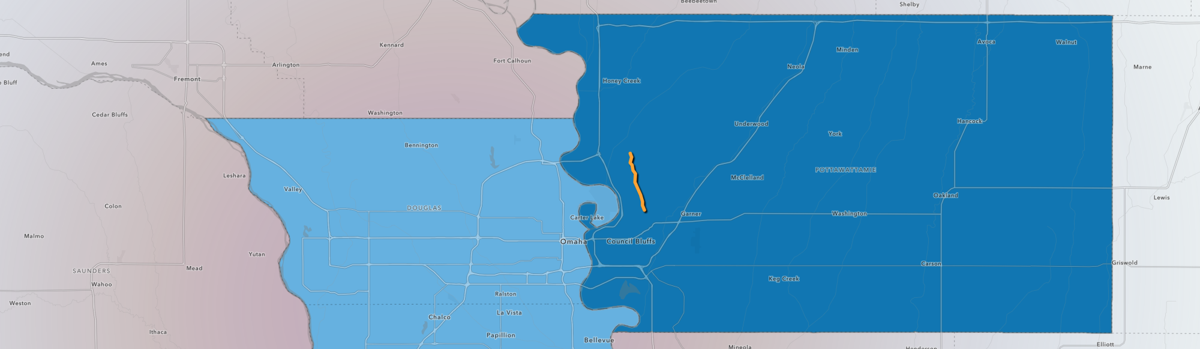
Pottawattamie County has been awarded $19.9 million in federal funding through the U.S. Department of Transportation's Safe Streets and Roads for All (SS4A) program, marking a significant investment in roadway safety and infrastructure throughout the county.
The award, announced October 30, is the largest SS4A grant awarded in Iowa during the 2026 funding cycle and the fifth-largest nationwide out of nearly 300 recipients. The funding will support the Old Lincoln Highway Corridor Safety Project, a nearly $25 million initiative focused on improving one of the county's highest-risk roadways and advancing pedestrian safety improvements in smaller communities.
"This is an incredible opportunity to make meaningful, lasting improvements to roadway safety in Pottawattamie County," said Andy Wicks, Pottawattamie County Engineer. "The Board of Supervisors has made roadway safety a priority, and securing this funding allows us to turn that commitment into action. Not only will we be able to address longstanding safety concerns along Old Lincoln Highway, but we'll also have an opportunity to partner with communities across the county to make local streets safer for pedestrians."
People are also reading…
Addressing safety concerns along Old Lincoln Highway
The primary focus of the project is an 11.6-mile stretch of Old Lincoln Highway between Sumac Road near Honey Creek and Coit Road near the Council Bluffs city limits, including the portion passing through Crescent.
The corridor was identified as one of the county's highest-risk roadways through its comprehensive Safety Action Plan, completed in 2025. Between 2019 and 2023, the corridor experienced 121 crashes, including four fatal crashes and eight crashes resulting in serious injuries.
Nearly half of those crashes involved vehicles leaving the roadway, highlighting the need for improvements to roadway alignment, shoulders, visibility and roadside conditions.
Planned improvements include reconstructing and reconfiguring portions of Old Lincoln Highway to smooth curves and improve roadway geometry, adding extended paved shoulders, installing center and edge line rumble strips, upgrading pavement markings and signage, and addressing roadside hazards.
The project also includes improvements through Crescent, where the roadway transitions from a rural highway to a more developed community setting. The design and construction of this section will be done in coordination with city officials.
Based on the county's Safety Action Plan, the proposed improvements are projected to prevent approximately 10 crashes annually, including an estimated one fatal or serious injury crash per year. The analysis also estimates more than $5.6 million in annual avoided societal costs associated with crashes.
Improving pedestrian safety in county communities
In addition to improvements along Old Lincoln Highway, the grant will support efforts to improve pedestrian crossings in smaller communities throughout Pottawattamie County.
The project includes engineering studies and planning for rectangular rapid flashing beacons (RRFBs), pedestrian-activated warning devices designed to increase driver awareness at crosswalks.
Preliminary locations identified for evaluation include Avoca, Crescent, Neola, Oakland, Treynor, Underwood and Walnut. Final locations and improvements will be determined through engineering evaluations and coordination with participating communities.
A major investment in county infrastructure
The $19.9 million federal award will cover 80% of the project's $24.875 million total cost, with Pottawattamie County providing the remaining $4.975 million through its Secondary Roads operating budget.
The grant was awarded through the SS4A Implementation Grant program, which provides federal funding to put roadway safety improvements into action. Unlike planning grants, implementation funding supports projects that directly address identified safety risks.
The award builds on the county's previously completed Safety Action Plan, which used crash data, roadway conditions and community input to identify locations where safety improvements could have the greatest impact.
Project development will take place over the next several years, beginning with grant agreement execution, design, environmental review and engineering studies. Construction could start as early as 2029 and continue through 2031, subject to final design, approvals and project scheduling.
Throughout the process, the county will coordinate with residents, affected property owners, local communities and regional transportation partners to share information, gather input and minimize disruptions.
"This investment represents an important step forward in our ongoing commitment to safer roads," Wicks said. "By combining federal resources with local investment and working alongside our communities, we can make improvements that will benefit residents and travelers for generations to come."